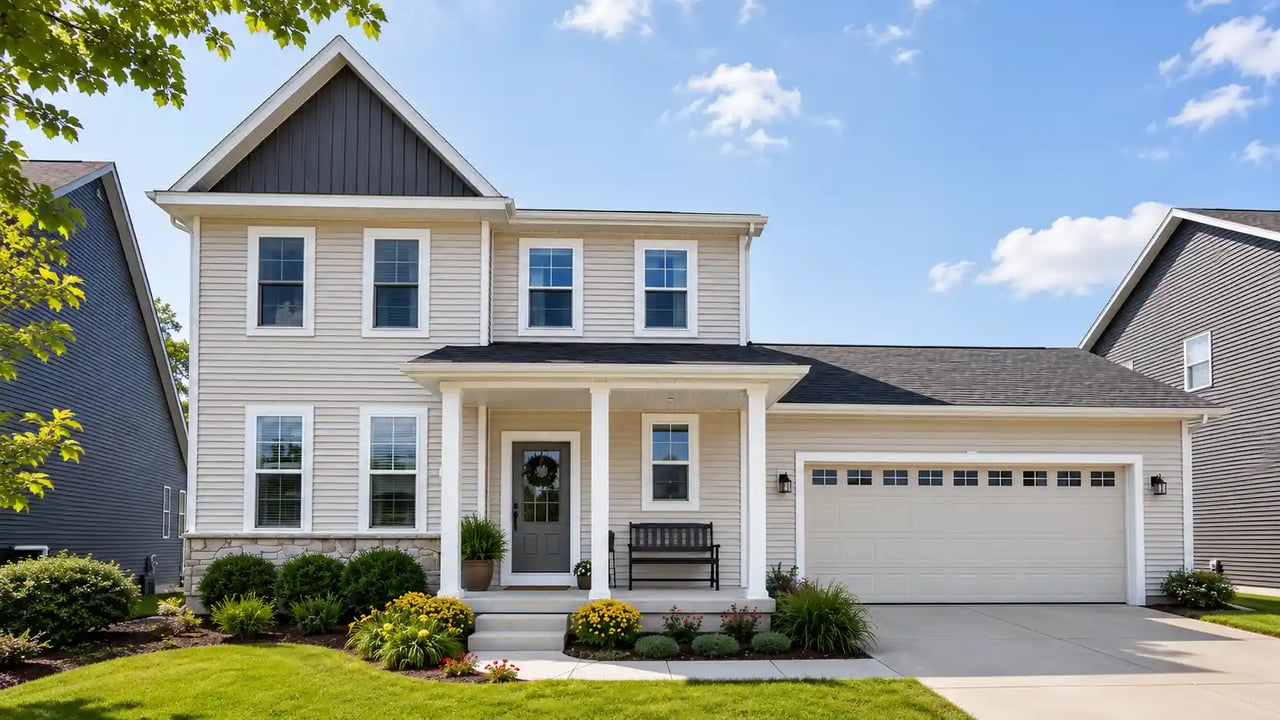
You already know the drill. Type your address into a valuation website, wait a few seconds, and a number appears. It looks precise enough to feel like an answer. If you are thinking about selling a home in Madison or elsewhere in Dane County, it can be hard not to treat that number as the starting line for every decision that follows.
At MHB, we do not think the problem is that online estimates exist. The problem is when a two-second estimate is asked to do a job it was never designed to do. Pricing a home well requires more than a number. It requires understanding the property, the competition, the seller's goals, and how buyers are behaving in that specific part of the market.
That is why MHB does not replace one generic estimate with another. Our pricing process uses a property-specific 42-point market analysis and the judgment of full-time career agents who work the greater Madison market every day. The goal is not to hand you the highest number in the room. It is to build a pricing strategy you can make a real decision around.
What an Online Home Valuation Actually Measures
Online valuation tools are useful because they can process a large amount of public information quickly. They may draw from public records, tax data, property characteristics, and recent nearby sales to estimate a likely value.
In a neighborhood with plenty of recent, similar sales, that can produce a reasonable ballpark. But the output is still a model. It does not know why one house on a street drew multiple offers while another sat. It cannot walk through your kitchen, see the quality of a remodel, notice deferred maintenance, evaluate the way the lot feels, or understand how your home stacks up against the listings buyers can choose from right now.
MHB's approach starts where the algorithm stops: with the actual property and the actual decision the seller is trying to make.
Why the Same Data Can Lead to a Different Pricing Strategy
Two homes can share a bedroom count, similar square footage, and the same school district while competing very differently once they hit the market. One may have a finished lower level, newer mechanicals, better natural light, a more usable yard, or an update buyers are actively rewarding. The other may need work that is not obvious in public records.
That is why our market analysis is not a basic comparable-sales printout. MHB's 42-point process looks at the home itself, relevant market data, current competition, and the seller's motivations before we recommend a pricing strategy. Closed sales matter, but so does what a buyer will see when your listing appears next to the homes that are active today.
That distinction is especially important in Dane County, where a property in Middleton, Verona, Fitchburg, Sun Prairie, Waunakee, or DeForest can behave differently from a superficially similar home only a few miles away.
Where a Formal Appraisal Fits - and Where It Does Not
A professional appraisal serves an important purpose, particularly in a financed transaction. But an appraisal and a pre-listing pricing strategy are not the same thing. One helps support a lender's opinion of value in a transaction; the other has to answer a seller's forward-looking question: how should this home be positioned when it enters the market?
Research from the Federal Housing Finance Agency found that appraisals confirmed or exceeded the agreed purchase price more than 90% of the time, with larger upward differences appearing more often in rural markets than urban ones. The point is not that appraisals are unreliable. It is that no single valuation method - automated or human - should be treated as a substitute for understanding the property and the market context around it.
For MHB, that context is the reason pricing is a process rather than a number.
What MHB's 42-Point Market Analysis Adds
MHB's pricing process is built around a 42-point market analysis unique to our team. We use relevant sales data, but we also evaluate the condition and features of the home, current competition, seller priorities, and the details that affect how buyers are likely to perceive the property.
The experience behind that analysis matters. MHB is not built around part-time agents or a high-turnover recruiting model. Our agents are full-time career professionals, and new agents train under senior agents for at least two years. Across more than 3,000 transactions, that creates a much deeper base of real-world pattern recognition than a pricing worksheet alone can provide.
It also means the recommendation does not depend on one person working in isolation. MHB was built as a collaborative firm. When a pricing question is unusual, the benefit is not simply one agent's opinion; it is access to a team that collectively handles hundreds of Dane County transactions in a typical year.
Could Your Home Be Worth More - or Less - Than the Online Number?
Absolutely. The online estimate can miss value, but it can miss drawbacks too. A renovated kitchen, finished basement, larger lot, newer roof or furnace, trail access, a quiet street, or a layout buyers prefer may not be reflected accurately in the model. The same is true of condition issues or functional limitations that public data cannot see.
That is why MHB does not begin a seller conversation by trying to prove the algorithm wrong in one direction. We begin by trying to understand what the market actually supports. Sometimes that confirms the online range. Sometimes it does not. Either answer is useful if it is grounded in the property rather than in what someone thinks the seller wants to hear.
The $5,000 Selling Strategy Supports the Philosophy - It Is Not the Pricing Advice
MHB became known for challenging the traditional percentage-based commission model, but that is only one expression of a larger idea: we do not keep doing something a certain way just because that is how real estate has always done it.
Our single $5,000 Selling Strategy is $500 upfront and $4,500 at closing after a successful sale. It does not become a larger fee just because the home is worth more. More importantly, it is still a full-service process: pricing strategy, staging and home-prep guidance, professional photo/video/drone marketing, MLS exposure, showing coordination, negotiations, and contract-to-close management are part of the same model.
The fee is not the reason to trust a valuation. The reason is the work behind it: experienced full-time agents, a structured 42-point analysis, local transaction volume, and a process designed around the seller's decision rather than the agent's convenience. The fee simply proves that MHB is willing to rethink an industry convention when we believe clients are better served another way.
Home Valuation Questions We Hear Often
Is an online home value estimate accurate?
Use it as a starting range, not a listing price. It can be useful for curiosity and early planning, but it cannot fully account for your home's condition, updates, current competition, or the way buyers are responding in your specific part of Dane County.
How much does a professional appraisal cost?
In the transaction guidance we give buyers, we typically budget about $400 to $600 for a lender-ordered appraisal. The exact cost can vary by property and assignment.
What makes MHB's market analysis different?
MHB uses a property-specific 42-point market analysis, then develops pricing strategy around the home, relevant market data, current competition, and the seller's goals. It is designed to determine how the property should be positioned, not simply to produce an estimated value.
Ready for a Number You Can Actually Use?
You do not need to have a listing date picked before talking with us. MHB starts with a no-obligation conversation about the home, your timing, and what you are trying to accomplish. From there, we can help you understand what the market supports and what the next step should be - even if the right answer is not to sell yet.